- Posts: 913
The Spider in the Urinal & The Issue of Non-interference
10 Aug 2017 11:13 - 10 Aug 2017 11:19 #296310
by Brick

The Spider in the Urinal & The Issue of Non-interference was created by Brick
This was originally going to be a response to Reacher's thread '
Dialectic: The Nature of Reality
' (which I will respond to later today), but I didn't want to derail the conversation between him and Adder. I would however recommend that people read Reacher's OP first as this thread is kind of linked to that, specifically the first video involving the 3 prisoners.
My question revolves around the morality of the escapee's decision to return to the prisoners in the cave and try and inform them of the outside world. Especially given that they were tied up, and he did not appear to be able to free them. It reminded me of the story of 'The Spider in the Urinal' by Thomas Nagel, in his essay 'Birth, Death, and the Meaning of Life'. It addresses the issue of non-interference.
For those unfamiliar with this tale I'll summarise:
Nagel acted out of empathy, thinking he was helping the spider, but in reality the opposite was true. Much like the escapee in Plato's Cave.
It's an interesting tale because because it asks us to consider 'How can we ever know what anyone really wants?' Nagel was positive that the spider would want out of the urinal just as the escapee was positive the other prisoners would want to know of the world outside.
It also forces us to question our policies of intervention. Despite our best intentions, interference can sometimes inflict unanticipated harm.
So, I suppose my question is really do you think Nagel and/or the escapee were right in their decision even it though things didnt work out the way they intended it to? And how do you guys decide when is the right time to intervene in certain events and when is it best to leave them alone? What are the things you consider?
I'd love to hear your thoughts
My question revolves around the morality of the escapee's decision to return to the prisoners in the cave and try and inform them of the outside world. Especially given that they were tied up, and he did not appear to be able to free them. It reminded me of the story of 'The Spider in the Urinal' by Thomas Nagel, in his essay 'Birth, Death, and the Meaning of Life'. It addresses the issue of non-interference.
For those unfamiliar with this tale I'll summarise:
Whilst visiting the restroom one day, Nagel noticed a small spider in one of the urinals. To Nagel, the spider was living an awful life, constantly being peed on. Every time Nagel used the restroom he felt worse and worse for this poor little spider, because he was trapped by the smooth porcelain overhang, there was no way for him to get out if he wanted to, and no way to tell whether he wanted to. Finally, at the end of the term, Nagel took a paper towel and extended it to the spider. The spider grasped the end of the paper towel and Nagel lifted him up and put him down on the floor.
The spider just sat there, unmoving, Nagel nudged him with the paper towel but nothing happened. 2 hours later the spider was still there. The next day his legs were shriveled in that way dead spiders so often are. His corpse stayed there for a week, until they finally swept the floor.
Nagel acted out of empathy, thinking he was helping the spider, but in reality the opposite was true. Much like the escapee in Plato's Cave.
It's an interesting tale because because it asks us to consider 'How can we ever know what anyone really wants?' Nagel was positive that the spider would want out of the urinal just as the escapee was positive the other prisoners would want to know of the world outside.
It also forces us to question our policies of intervention. Despite our best intentions, interference can sometimes inflict unanticipated harm.
So, I suppose my question is really do you think Nagel and/or the escapee were right in their decision even it though things didnt work out the way they intended it to? And how do you guys decide when is the right time to intervene in certain events and when is it best to leave them alone? What are the things you consider?
I'd love to hear your thoughts
Apprentice to Maitre Chevalier Jedi
Alexandre Orion
Moderator | Welcome Team | IP Team
IP Journal
|
IP Journal 2
|
AP Journal
|
Open Journal
- Knight Senan'The only contest any of us should be engaged in is with ourselves, to be better than yesterday'
Last edit: 10 Aug 2017 11:19 by Brick.
Please Log in to join the conversation.

10 Aug 2017 12:56 - 10 Aug 2017 13:00 #296337
by Edan
"Evil is always possible. And goodness is eternally difficult."
Replied by Edan on topic The Spider in the Urinal & The Issue of Non-interference
For me it's about the balance of probability... if I do X, what is likely to happen? How acceptable is that outcome? Acceptability is also about other's perceptions as well as mine, but that doesn't mean that I have to stop based on of how unacceptable they might think my actions are.
For all we know, Nagel's spider was about to pop its clogs anyway.. his interference may have made no difference to the outcome of that spider's life.
In truth, it's entirely about the situation.
On the balance of probability a spider in a urinal is less likely to survive than one out of a urinal, and in that place I would have chosen to 'save' the spider.
Were it a human stuck in a urinal, I probably would have left them to it.
Edit: Regarding the escapees.. they say ignorance is bliss.. but I also believe in knowledge even when that knowledge is difficult or painful to hear.
For all we know, Nagel's spider was about to pop its clogs anyway.. his interference may have made no difference to the outcome of that spider's life.
In truth, it's entirely about the situation.
On the balance of probability a spider in a urinal is less likely to survive than one out of a urinal, and in that place I would have chosen to 'save' the spider.
Were it a human stuck in a urinal, I probably would have left them to it.
Edit: Regarding the escapees.. they say ignorance is bliss.. but I also believe in knowledge even when that knowledge is difficult or painful to hear.
"Evil is always possible. And goodness is eternally difficult."
Last edit: 10 Aug 2017 13:00 by Edan.
Please Log in to join the conversation.
10 Aug 2017 13:26 #296343
by Brick
Thanks for the response Edan
I too would have 'saved' the spider in that instance, but I don't think I have told the prisoners about the outside world.
They say 'seeing is believing', and with no way of showing them the world outside, or helping them to get free from the cave and into the outside world, I don't see what purpose it would have served. I could only see two outcomes from telling them, either they'd not believe me without evidence and therefore accuse me of being mad (which is what happened in Plato's tale), or they would believe me and therefore spend the rest of their lives being miserable because they're unable to see the ideal.
Replied by Brick on topic The Spider in the Urinal & The Issue of Non-interference
Edan wrote: ... I would have chosen to 'save' the spider.
Were it a human stuck in a urinal, I probably would have left them to it.
Edit: Regarding the escapees.. they say ignorance is bliss.. but I also believe in knowledge even when that knowledge is difficult or painful to hear.
Thanks for the response Edan
I too would have 'saved' the spider in that instance, but I don't think I have told the prisoners about the outside world.
They say 'seeing is believing', and with no way of showing them the world outside, or helping them to get free from the cave and into the outside world, I don't see what purpose it would have served. I could only see two outcomes from telling them, either they'd not believe me without evidence and therefore accuse me of being mad (which is what happened in Plato's tale), or they would believe me and therefore spend the rest of their lives being miserable because they're unable to see the ideal.
Apprentice to Maitre Chevalier Jedi
Alexandre Orion
Moderator | Welcome Team | IP Team
IP Journal
|
IP Journal 2
|
AP Journal
|
Open Journal
- Knight Senan'The only contest any of us should be engaged in is with ourselves, to be better than yesterday'
Please Log in to join the conversation.
-

- User
-

Less
More
10 Aug 2017 13:27 #296344
by
Balance of probabilities is a good place to start when considering our actions, but we must be mindful that we can only interpret a situation from our own perspective which may or may not coincide with the outlook of the one we seek to help. Care should be taken not to impose our principles and standards on another not willing to accept them.
For illustrative purposes, generations ago the government of my country decided the children of the first people of this country would be 'better off' being raised according to the government's standards and implemented a policy of (forcibly) removing those children from their parents and communities. Not only is there no way of determining if those children really did receive any advantage but the policy only served to divide the people of our country rather than improving integration - the damage done is still being felt to this day.
In the example of the prisoners in the cave, there is no way of knowing they will never escape; after all one of them already did. By returning and feeding them the knowledge they are being denied the opportunity to discover it for themselves.
I think the key is to recognise that none of us has all the answers and that whilst we should always strive to be available to help those who may benefit from it, they must want the help. All of us are on our own path and should be empowered to follow it. For the record, I too would have extended the paper towel to the spider - it's up to the spider to take the opportunity or not.
Replied by on topic The Spider in the Urinal & The Issue of Non-interference
Terry Goodkind wrote: Wizard's Second Rule: "The greatest harm can result from the best intentions."
~ Stone of Tears, Chapter 63, page 886
Balance of probabilities is a good place to start when considering our actions, but we must be mindful that we can only interpret a situation from our own perspective which may or may not coincide with the outlook of the one we seek to help. Care should be taken not to impose our principles and standards on another not willing to accept them.
For illustrative purposes, generations ago the government of my country decided the children of the first people of this country would be 'better off' being raised according to the government's standards and implemented a policy of (forcibly) removing those children from their parents and communities. Not only is there no way of determining if those children really did receive any advantage but the policy only served to divide the people of our country rather than improving integration - the damage done is still being felt to this day.
In the example of the prisoners in the cave, there is no way of knowing they will never escape; after all one of them already did. By returning and feeding them the knowledge they are being denied the opportunity to discover it for themselves.
I think the key is to recognise that none of us has all the answers and that whilst we should always strive to be available to help those who may benefit from it, they must want the help. All of us are on our own path and should be empowered to follow it. For the record, I too would have extended the paper towel to the spider - it's up to the spider to take the opportunity or not.
Please Log in to join the conversation.
-
- User
-
Less
More
10 Aug 2017 14:53 #296372
by
Replied by on topic The Spider in the Urinal & The Issue of Non-interference
I picked up a book awhile back...got most of the way through it before I was siderailed with something else...but totally need to go back and read it again from the beginning.
The Conceit of Humanitarian Intervention - by Rajan Menon
The general topic of the book is on quite a larger scale than "rescuing" a spider from a urinal, but I think the root message is very similar. We struggle with this in Western societies, where we look down on other peoples and assume that they need/want our assistance to "better" their lives/conditions. History suggests this is not particularly true, perhaps at all, yet we cannot buck the notion that everyone else in the world doesn't want what we have. In a sense, our own arrogance and appreciation for our values and lifestyle creates an illusion of success that we presume all other like beings would also appreciate.
Consider, for an immediate example, the conditions of North Korea. That population has lived at a nearly polar-opposite level of what we deem to be our own success for the better half of a century or more. We have yet to allow relations escalate to that "line-in-the-sand" point, thus far, as I suspect that all other would-be interventionists acknowledge the immediate humanitarian challenges any such conflict would carry.
At what point here do we treat North Korea as a spider in the urinal, and should we rescue them to the floor, or let them find their way over the porcelain lip, should they decide to?
The Conceit of Humanitarian Intervention - by Rajan Menon
The general topic of the book is on quite a larger scale than "rescuing" a spider from a urinal, but I think the root message is very similar. We struggle with this in Western societies, where we look down on other peoples and assume that they need/want our assistance to "better" their lives/conditions. History suggests this is not particularly true, perhaps at all, yet we cannot buck the notion that everyone else in the world doesn't want what we have. In a sense, our own arrogance and appreciation for our values and lifestyle creates an illusion of success that we presume all other like beings would also appreciate.
Consider, for an immediate example, the conditions of North Korea. That population has lived at a nearly polar-opposite level of what we deem to be our own success for the better half of a century or more. We have yet to allow relations escalate to that "line-in-the-sand" point, thus far, as I suspect that all other would-be interventionists acknowledge the immediate humanitarian challenges any such conflict would carry.
At what point here do we treat North Korea as a spider in the urinal, and should we rescue them to the floor, or let them find their way over the porcelain lip, should they decide to?
Please Log in to join the conversation.
10 Aug 2017 15:59 #296396
by Brick
Replied by Brick on topic The Spider in the Urinal & The Issue of Non-interference
Great example both of you! Thank you for commenting.

I think that last bit is particularly important, which Sam alluded too as well, we can only ever truly help those that want to be helped. It's like the expression 'you can lead a horse to water but you cant him drink'Dano Ori wrote: I think the key is to recognise that none of us has all the answers and that whilst we should always strive to be available to help those who may benefit from it, they must want the help
Apprentice to Maitre Chevalier Jedi
Alexandre Orion
Moderator | Welcome Team | IP Team
IP Journal
|
IP Journal 2
|
AP Journal
|
Open Journal
- Knight Senan'The only contest any of us should be engaged in is with ourselves, to be better than yesterday'
The following user(s) said Thank You: Reacher
Please Log in to join the conversation.
-
- User
-
Less
More
10 Aug 2017 17:28 #296419
by
Yet...at the same time...that expression also assumes the horse wants to be near water...or that if the horse were in need of water he wouldn't go there himself?
That spurs a question of the little saying "Give a man a fish, feed him for a day; Teach a man to fish, feed him for a lifetime." Allegorical and what not, sure, but whose to say the guy even likes to eat fish? Perhaps when we consider trying to influence or intervene in the lives of others at all...we should assess first whether we have been asked to assist. Otherwise, we are just making assumptions based upon the world as we see it, and nothing more.
*Insert "you know what happens when you assume" line*
Replied by on topic The Spider in the Urinal & The Issue of Non-interference
Brick wrote: Great example both of you! Thank you for commenting.
I think that last bit is particularly important, which Sam alluded too as well, we can only ever truly help those that want to be helped. It's like the expression 'you can lead a horse to water but you cant him drink'Dano Ori wrote: I think the key is to recognise that none of us has all the answers and that whilst we should always strive to be available to help those who may benefit from it, they must want the help
Yet...at the same time...that expression also assumes the horse wants to be near water...or that if the horse were in need of water he wouldn't go there himself?
That spurs a question of the little saying "Give a man a fish, feed him for a day; Teach a man to fish, feed him for a lifetime." Allegorical and what not, sure, but whose to say the guy even likes to eat fish? Perhaps when we consider trying to influence or intervene in the lives of others at all...we should assess first whether we have been asked to assist. Otherwise, we are just making assumptions based upon the world as we see it, and nothing more.
*Insert "you know what happens when you assume" line*
Please Log in to join the conversation.
10 Aug 2017 20:00 #296452
by Reacher
Jedi Knight
The self-confidence of the warrior is not the self-confidence of the average man. The average man seeks certainty in the eyes of the onlooker and calls that self-confidence. The warrior seeks impeccability in his own eyes and calls that humbleness. The average man is hooked to his fellow men, while the warrior is hooked only to infinity.
Replied by Reacher on topic The Spider in the Urinal & The Issue of Non-interference
So for the allegory of Plato's cave to be valid, a person must ascribe to Plato's
Theory of Forms
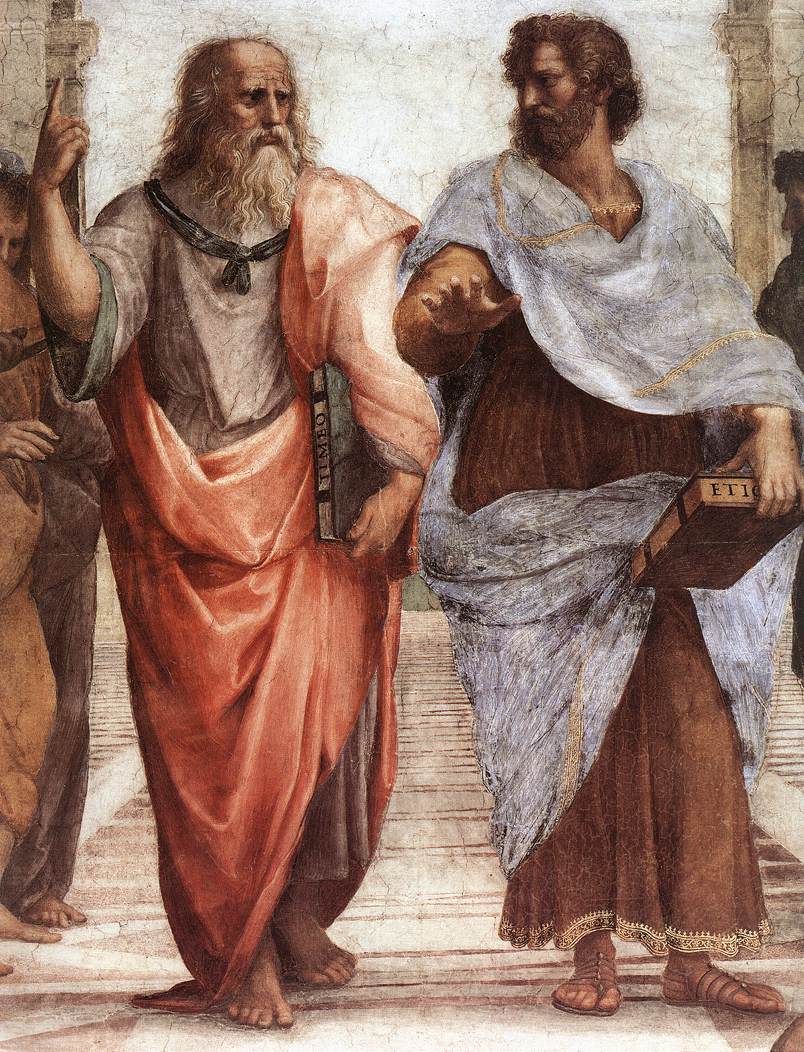
. Basically, the idea is that everything has an 'essence', and intangible ideal of itself that is expressed by the imperfection of perceived reality. If Plato's perception of reality is 'right', then ethically speaking he has much more justification in his desire to let the prisoners go. If he is wrong, then releasing the prisoners is an exercise in interference. Plato does admit that this theory does have limitations, but it also has some serious strengths. This conception of reality is part of the intellectual tradition that spawned objective scientific method - that did some good things for us. Without this proto-idea, objectivity is not really a thing. As part of that tradition, Plato's pupil Aristotle contrasted Plato's idea of Forms by saying that anything we know can ONLY be based on
empirical
, sensory observation. There is a great painting called The School of Athens by Raphael that captures the dialogue between these two philosophies. Here is a piece of it where Plato is pointing up, signifying Form, and Aristotle is gesturing to the world around him:
One of the big issues stemming from the idea of Forms is categorization. We can neck down animals from Kingdom, Phylum...on down...but how do you assign less ordered things to Forms...like beauty? Two vastly dissimilar things might fall under an intangible category of 'beautiful.' So yeah, issues abound.
Back to our poor spider bro. Is this analogous to Plato's Cave? I think Plato would say no - that his theory of reality is valid and comparing spider bro to the cave is apples and oranges. I think fellas like Sun Tzu, Confucius, and Mencius would see some echoes of analogy, though. They might see spider bro as it relates to the harmony of the other things around it. Interference might upset that balance. Or, they might see him as discordant from what other 'like' creatures generally are and move him as well. Whichever they choose, they would choose not from the 'objective' idea that spiders don't belong in urinals, and that getting peed on is degrading. They would choose from what they believe is the most harmonious version of subjective reality. Lots of thought buildout for essentially two choices, eh? I contend that this explains some of the differences between Jedi and Sith - you might see two folks who achieve the same degree of excellence, work equally as hard, and possess similar skillsets. Those attributes and personal drives simply stem from different conceptions of reality.
On the North Korea analogy, I was thinking...we don't really know how spider bro found himself in the urinal. Maybe he jumped there. Maybe he was born there. Maybe he recognized his only chance at life was to wash himself in the waters of others on the reg. But...if someone consciously constructed that bowl and meant to use it as a way to prevent spider bro from having the choice to leave - that might be more related to the North Korea scenario. If the west decides to interfere, it won't be out of love for our North Korean spider bros caught in a bowl that no one made. Someone made it. Someone keeps making it. And if interference does occur, it'll be because it is in our interests to interfere. That is an entirely different ball of wax that would need its own thread.
Brick...I have to say - this is fantastic. Thank you for opening up thisdiscussion!
One of the big issues stemming from the idea of Forms is categorization. We can neck down animals from Kingdom, Phylum...on down...but how do you assign less ordered things to Forms...like beauty? Two vastly dissimilar things might fall under an intangible category of 'beautiful.' So yeah, issues abound.
Back to our poor spider bro. Is this analogous to Plato's Cave? I think Plato would say no - that his theory of reality is valid and comparing spider bro to the cave is apples and oranges. I think fellas like Sun Tzu, Confucius, and Mencius would see some echoes of analogy, though. They might see spider bro as it relates to the harmony of the other things around it. Interference might upset that balance. Or, they might see him as discordant from what other 'like' creatures generally are and move him as well. Whichever they choose, they would choose not from the 'objective' idea that spiders don't belong in urinals, and that getting peed on is degrading. They would choose from what they believe is the most harmonious version of subjective reality. Lots of thought buildout for essentially two choices, eh? I contend that this explains some of the differences between Jedi and Sith - you might see two folks who achieve the same degree of excellence, work equally as hard, and possess similar skillsets. Those attributes and personal drives simply stem from different conceptions of reality.
On the North Korea analogy, I was thinking...we don't really know how spider bro found himself in the urinal. Maybe he jumped there. Maybe he was born there. Maybe he recognized his only chance at life was to wash himself in the waters of others on the reg. But...if someone consciously constructed that bowl and meant to use it as a way to prevent spider bro from having the choice to leave - that might be more related to the North Korea scenario. If the west decides to interfere, it won't be out of love for our North Korean spider bros caught in a bowl that no one made. Someone made it. Someone keeps making it. And if interference does occur, it'll be because it is in our interests to interfere. That is an entirely different ball of wax that would need its own thread.
Brick...I have to say - this is fantastic. Thank you for opening up thisdiscussion!
Jedi Knight
The self-confidence of the warrior is not the self-confidence of the average man. The average man seeks certainty in the eyes of the onlooker and calls that self-confidence. The warrior seeks impeccability in his own eyes and calls that humbleness. The average man is hooked to his fellow men, while the warrior is hooked only to infinity.
The following user(s) said Thank You: Brick, ,
Please Log in to join the conversation.
-
- User
-
Less
More
10 Aug 2017 20:47 #296459
by
Replied by on topic The Spider in the Urinal & The Issue of Non-interference
I am the first to admit that I am not filled with complicated philosophical knowledge. These recent discussions are so interesting, and I love learning about all of them.
I guess I approach this type of problem from a spiritual perspective... since mysticism is really my field of study. In this case, either choice is wrong, depending on the point of view you look from. On the one hand, helping spiderbro builds a sense of internal empathy. You decided that you wouldn't like to be peed on every day, and you put yourself in the spider's place. You would want somebody to help you.
But, we know nothing of the spider. Perhaps spiderbro was already dying, hence why he hadn't moved. Perhaps it was the best place to catch bugs, and who cares about piss? I'm sure he didn't mind too much.
We cannot put ourselves totally in the spider's position. We don't understand spiders. We know about spiders.. but, who among us is a spider expert?
Now, what if you were a spider expert. You probably would have made a different choice. Knowing more about their behavior, maybe you would have chosen a different method of transport. Maybe you would have known that the spider wanted to be where he was.
Compassion and Empathy are much more complex than "put yourself in somebody's position". Even more so when the other being is not a human. At least then you'd have similar perspectives to work from.
Now... since I am a mystic, I should also say that this metaphorically can relate to spiritual service. If we can see each other through the Force, then compassion can be shown in a way that works most benevolently. But, if we see each other only through our eyes, then our egos and our own perspectives can get in the way.
What if the most benevolent action we could have taken was to stand outside on a street corner yelling to a cloud about the spider? Of course, it's probably not... but, when we "think" and "process", we can oftentimes either over- or under-think it.
It's complicated. Lovely topic, thanks for sharing.
I guess I approach this type of problem from a spiritual perspective... since mysticism is really my field of study. In this case, either choice is wrong, depending on the point of view you look from. On the one hand, helping spiderbro builds a sense of internal empathy. You decided that you wouldn't like to be peed on every day, and you put yourself in the spider's place. You would want somebody to help you.
But, we know nothing of the spider. Perhaps spiderbro was already dying, hence why he hadn't moved. Perhaps it was the best place to catch bugs, and who cares about piss? I'm sure he didn't mind too much.
We cannot put ourselves totally in the spider's position. We don't understand spiders. We know about spiders.. but, who among us is a spider expert?
Now, what if you were a spider expert. You probably would have made a different choice. Knowing more about their behavior, maybe you would have chosen a different method of transport. Maybe you would have known that the spider wanted to be where he was.
Compassion and Empathy are much more complex than "put yourself in somebody's position". Even more so when the other being is not a human. At least then you'd have similar perspectives to work from.
Now... since I am a mystic, I should also say that this metaphorically can relate to spiritual service. If we can see each other through the Force, then compassion can be shown in a way that works most benevolently. But, if we see each other only through our eyes, then our egos and our own perspectives can get in the way.
What if the most benevolent action we could have taken was to stand outside on a street corner yelling to a cloud about the spider? Of course, it's probably not... but, when we "think" and "process", we can oftentimes either over- or under-think it.
It's complicated. Lovely topic, thanks for sharing.
Please Log in to join the conversation.
-
- User
-
Less
More
10 Aug 2017 20:58 #296461
by
Replied by on topic The Spider in the Urinal & The Issue of Non-interference
I always pee on the spider, every time. I'm must be bad at Jediing.....
Please Log in to join the conversation.
-
- User
-
Less
More
10 Aug 2017 22:41 #296469
by
Replied by on topic The Spider in the Urinal & The Issue of Non-interference
I just wanted to add that in extending the paper towel to the spider I would then walk the spider out of the building to the garden rather than leave him on the floor.
Often those that intervene 'to help' (I'm referring here to a number of welfare agencies I deal with through work) do so up to the point of removing someone from a bad situation, but they then fail to provide an environment where that person can thrive. If we shoulder the responsibility of 'helping' we should be prepared to see that course of action through rather than offer half measures and "we'll you're better off than you were".
Perhaps the questions to be asked are:
Often those that intervene 'to help' (I'm referring here to a number of welfare agencies I deal with through work) do so up to the point of removing someone from a bad situation, but they then fail to provide an environment where that person can thrive. If we shoulder the responsibility of 'helping' we should be prepared to see that course of action through rather than offer half measures and "we'll you're better off than you were".
Perhaps the questions to be asked are:
- Is help needed?
- Is help wanted?
- What help is needed/wanted?
- Do I have the capacity to provide that help?
Please Log in to join the conversation.
10 Aug 2017 23:13 - 10 Aug 2017 23:17 #296475
by JamesSand
Replied by JamesSand on topic The Spider in the Urinal & The Issue of Non-interference
Oh come on! Surely all y'all Edit: Super Cool Dudes /Edit watch Star Trek!?
https://www.youtube.com/watch?v=ppykquyAUyY
https://www.youtube.com/watch?v=4mH-L6UCCAE
https://www.youtube.com/watch?v=ppykquyAUyY
https://www.youtube.com/watch?v=4mH-L6UCCAE
Last edit: 10 Aug 2017 23:17 by JamesSand.
The following user(s) said Thank You: Brick
Please Log in to join the conversation.
-
- User
-
Less
More
10 Aug 2017 23:21 #296477
by
Replied by on topic The Spider in the Urinal & The Issue of Non-interference
Not the dreaded nickname generator! Ok everyone knows that true starship captains never follow the prime directive. So the spider dies for the good of the bowl.
Please Log in to join the conversation.
-
- User
-
Less
More
11 Aug 2017 04:22 - 11 Aug 2017 04:25 #296509
by
Replied by on topic The Spider in the Urinal & The Issue of Non-interference
First of all, who waits as long as the story author does to help? Why on earth would you let any creature suffer for even a moment? The spider WANTED rescuing... it reached. Who am I to demean it by telling it that it's better off where it is?
It is arrogance to not allow each person the chance to be more. If they're not ready for it... THEY should be the ones to decide that. That moment spent dying on the floor might have been that spider's nirvana for all we know. Any knowledge worth possessing requires a sacrifice of some sort... are we so afraid of death that we can't see the value in suffering for knowledge/truth? Maybe the spider was the happiest it ever had been. Who knows what it experienced?
But putting yourself in the position of a god by judging someone else as "not ready" is an arrogance I hope to avoid owning.
Always offer, never force. Let the student lead themselves.
It is arrogance to not allow each person the chance to be more. If they're not ready for it... THEY should be the ones to decide that. That moment spent dying on the floor might have been that spider's nirvana for all we know. Any knowledge worth possessing requires a sacrifice of some sort... are we so afraid of death that we can't see the value in suffering for knowledge/truth? Maybe the spider was the happiest it ever had been. Who knows what it experienced?
But putting yourself in the position of a god by judging someone else as "not ready" is an arrogance I hope to avoid owning.
Always offer, never force. Let the student lead themselves.
Last edit: 11 Aug 2017 04:25 by .
Please Log in to join the conversation.
11 Aug 2017 08:13 #296639
by Brick
Thank you for such an in depth response. Once again you've given me a lot to think about. I love the picture by the way. Most of what I have to say in response to your post revolves around the first half and I think ties into what I want to say in our discussion in your Nature of Reality thread, so I'll respond to it there, I hope thats ok.
Though I must say that I really liked how you related all of this to the differences between Jedi and Sith and their understanding of reality.
Replied by Brick on topic The Spider in the Urinal & The Issue of Non-interference
Reacher wrote: Back to our poor spider bro. Is this analogous to Plato's Cave? I think Plato would say no - that his theory of reality is valid and comparing spider bro to the cave is apples and oranges. I think fellas like Sun Tzu, Confucius, and Mencius would see some echoes of analogy, though. They might see spider bro as it relates to the harmony of the other things around it. Interference might upset that balance. Or, they might see him as discordant from what other 'like' creatures generally are and move him as well. Whichever they choose, they would choose not from the 'objective' idea that spiders don't belong in urinals, and that getting peed on is degrading. They would choose from what they believe is the most harmonious version of subjective reality. Lots of thought buildout for essentially two choices, eh? I contend that this explains some of the differences between Jedi and Sith - you might see two folks who achieve the same degree of excellence, work equally as hard, and possess similar skillsets. Those attributes and personal drives simply stem from different conceptions of reality.
Thank you for such an in depth response. Once again you've given me a lot to think about. I love the picture by the way. Most of what I have to say in response to your post revolves around the first half and I think ties into what I want to say in our discussion in your Nature of Reality thread, so I'll respond to it there, I hope thats ok.
Though I must say that I really liked how you related all of this to the differences between Jedi and Sith and their understanding of reality
.I agree that this probably does require its own thread, but I'd be really interested in hearing your take on this.Reacher wrote: And if interference does occur, it'll be because it is in our interests to interfere. That is an entirely different ball of wax that would need its own thread
Apprentice to Maitre Chevalier Jedi
Alexandre Orion
Moderator | Welcome Team | IP Team
IP Journal
|
IP Journal 2
|
AP Journal
|
Open Journal
- Knight Senan'The only contest any of us should be engaged in is with ourselves, to be better than yesterday'
Please Log in to join the conversation.
11 Aug 2017 08:43 #296642
by Brick
Replied by Brick on topic The Spider in the Urinal & The Issue of Non-interference
I'd like to thank you Snowy for presenting (as you so often do) a view point I had not considered. I understand your point but, playing devil's advocate here (as I so often do) :laugh: :
How do we know that the creature was suffering?Snowy Aftermath wrote: First of all, who waits as long as the story author does to help? Why on earth would you let any creature suffer for even a moment?
How do we know it WANTED rescuing? Yes, it reached for the towel, but we have no way of knowing if it knew that action would result in it being moved from the urinal.Snowy Aftermath wrote: The spider WANTED rescuing... it reached.
Who am I to demean it by telling it that it's better off somewhere else?Snowy Aftermath wrote: Who am I to demean it by telling it that it's better off where it is?
Or it might have been the worst moment of its existence, we'll never know.Snowy Aftermath wrote: That moment spent dying on the floor might have been that spider's nirvana for all we know.
ExactlySnowy Aftermath wrote: Any knowledge worth possessing requires a sacrifice of some sort... are we so afraid of death that we can't see the value in suffering for knowledge/truth? Maybe the spider was the happiest it ever had been. Who knows what it experienced?
Apprentice to Maitre Chevalier Jedi
Alexandre Orion
Moderator | Welcome Team | IP Team
IP Journal
|
IP Journal 2
|
AP Journal
|
Open Journal
- Knight Senan'The only contest any of us should be engaged in is with ourselves, to be better than yesterday'
Please Log in to join the conversation.
-
- User
-
Less
More
11 Aug 2017 12:10 - 11 Aug 2017 12:23 #296657
by
It may not have been. And the suffering of other spiders is also certainly worse, and other spiders have suffered infinitesimally compared to this spider. But regardless of the level of suffering, it has made the decision to latch on. Now what? Suppose I open the door and it becomes a lion and eats me. Suppose I do the same and it becomes a butterfly and harmlessly flies away. Suppose it carries a vaccination to save the world from all suffering, suppose it carries a new plague. Sometimes we kill our teachers, sometimes we harmlessly fly away, sometimes we save the world, sometimes we kill it. Sometimes we're overwhelmed or sick and die in the same place we landed. It's not my responsibility to predict the future. But when a thing is ready to have it's eyes opened, I will certainly be willing. It's what I became when released from my own urinal
And a human being has no way of knowing what is outside the cave until it gets there. Some folks can't handle life outside The Matrix. But we have no right to pronounce whether a person is capable of handling it or not for them.
You aren't making that call though, the spider has by extending it's leg and grabbing on. To not ever have had the chance would be the real crime though. Seekers gonna seek, compassionaters gonna compassionate. Savvy?
Like how many licks it takes to get to the center. *nods*
Basically this comes down to letting a seeker seek. It's not our job to decide who should be allowed to follow their pursuits and whether or not they are ready. Potential immediate death is always a possibility. You could always get creamed by a bus you didn't see coming too and not even get a chance to follow your dreams.
What happens when you step off that curb is the burden of freedom.
Ain't it grand?
Replied by on topic The Spider in the Urinal & The Issue of Non-interference
Brick wrote: I'd like to thank you Snowy for presenting (as you so often do) a view point I had not considered. I understand your point but, playing devil's advocate here (as I so often do) :laugh: :
How do we know that the creature was suffering?Snowy Aftermath wrote: First of all, who waits as long as the story author does to help? Why on earth would you let any creature suffer for even a moment?
It may not have been. And the suffering of other spiders is also certainly worse, and other spiders have suffered infinitesimally compared to this spider. But regardless of the level of suffering, it has made the decision to latch on. Now what? Suppose I open the door and it becomes a lion and eats me. Suppose I do the same and it becomes a butterfly and harmlessly flies away. Suppose it carries a vaccination to save the world from all suffering, suppose it carries a new plague. Sometimes we kill our teachers, sometimes we harmlessly fly away, sometimes we save the world, sometimes we kill it. Sometimes we're overwhelmed or sick and die in the same place we landed. It's not my responsibility to predict the future. But when a thing is ready to have it's eyes opened, I will certainly be willing. It's what I became when released from my own urinal
How do we know it WANTED rescuing? Yes, it reached for the towel, but we have no way of knowing if it knew that action would result in it being moved from the urinal.Snowy Aftermath wrote: The spider WANTED rescuing... it reached.
And a human being has no way of knowing what is outside the cave until it gets there. Some folks can't handle life outside The Matrix. But we have no right to pronounce whether a person is capable of handling it or not for them.
Who am I to demean it by telling it that it's better off somewhere else?Snowy Aftermath wrote: Who am I to demean it by telling it that it's better off where it is?
You aren't making that call though, the spider has by extending it's leg and grabbing on. To not ever have had the chance would be the real crime though. Seekers gonna seek, compassionaters gonna compassionate. Savvy?
Or it might have been the worst moment of its existence, we'll never know.Snowy Aftermath wrote: That moment spent dying on the floor might have been that spider's nirvana for all we know.
Like how many licks it takes to get to the center. *nods*
ExactlySnowy Aftermath wrote: Any knowledge worth possessing requires a sacrifice of some sort... are we so afraid of death that we can't see the value in suffering for knowledge/truth? Maybe the spider was the happiest it ever had been. Who knows what it experienced?
Basically this comes down to letting a seeker seek. It's not our job to decide who should be allowed to follow their pursuits and whether or not they are ready. Potential immediate death is always a possibility. You could always get creamed by a bus you didn't see coming too and not even get a chance to follow your dreams.
What happens when you step off that curb is the burden of freedom.
Ain't it grand?
Last edit: 11 Aug 2017 12:23 by .
Please Log in to join the conversation.
-
- User
-
Less
More
11 Aug 2017 13:44 #296676
by
Replied by on topic The Spider in the Urinal & The Issue of Non-interference
Maybe i am too simple for these kind of discussions but i would think that a spider can not survice on Pee alone so i would remove it and put it in the garden , even if that is against the spiders wishes who maybe is looking forward to his own demise, if spiders can think but then , when spiders can think then what the heck is he doing in the toilet , probably an accident , so again i would take action
As for us humans , we get into a lot of trouble , sometimes that is cummulative and we loose track of what got us into trouble , tricky territory.I would insist every heroine addict to be admitted to a clinic if it were not for that tricky little thing called free will. So free will can stop you from doing the right thing if you think the right thing is to treat addicted people.
In my opinion , to know when to act and when not to act is one of the hardest things to achieve , sometimes even its damned if you do , damned if you don't.
As for us humans , we get into a lot of trouble , sometimes that is cummulative and we loose track of what got us into trouble , tricky territory.I would insist every heroine addict to be admitted to a clinic if it were not for that tricky little thing called free will. So free will can stop you from doing the right thing if you think the right thing is to treat addicted people.
In my opinion , to know when to act and when not to act is one of the hardest things to achieve , sometimes even its damned if you do , damned if you don't.
Please Log in to join the conversation.
-
- User
-
Less
More
22 Aug 2017 14:58 #299146
by
Replied by on topic The Spider in the Urinal & The Issue of Non-interference
Driving my 7-year-old daughter to hockey the other day, she started the million questions game, asking me about what I will loosely summarize as "respect for all life." It was not incredibly unsolicited, we had other talks here and there over the past few months about how to be respectful to animals, appreciate the hard work of nature and all that's in it, to allow us the sustenance we need to survive: from plants, animals, clean water, all of it. I tossed my question at her a week or so ago about whether clouds were alive, or rainbows even, and towards the end of that she accepted that notion that just because something is not completely like us, it does not mean that it could not be something entirely that we simply do not understand. So it has been a developing discussion lately, this recent bout came out of no immediate example though.
It was a long talk (the drive out through traffic to the hockey rink can range between 30-45 minutes), and we covered everything from the ethics of a hunter, to the dedication of a farmer, and the general attitude of respect and appreciation we should exhibit for all life forms, whether we recognize them or not.
Later that day, after getting home, she was in the backyard playing with the dog, and I was sitting out on the front porch enjoying the approach of evening. She came running out through the garage excitedly calling for me, and quickly related some events as follows. She had been playing (probably cooking little buckets of dirt into a thanksgiving worthy buffet, and noticed a small beetle struggling in the dog's water bowl. Thinking about what we had talked about that morning, she took a small twig and gently allowed the beetle to latch on, then lifted it from the water and took it to a spot in the grass she had noticed other such bugs to be living. She said the beetle looked very happy, and danced around a bit before running off. She was very proud to have done something kind for another being. I am very proud of her too.
Naturally, I quickly thought back to this thread.
This morning I had another further thought, based upon this thread's discussion, my daughter's experience, and a comment from a senior member elsewhere recently about accidentally stepping on a snail. It made me wonder whether we can actual "intervene" in nature at all, or whether that is simply the course of how nature works entirely?
We often consider intervention in the case of the spider in the urinal, the beetle in the water bowl, or the snail on the pathway, as unique moments where we have a decision to make about how to interact with the universe. Are they important? Sure. Do wrong decisions have negative impacts of our interconnected universe? That we cannot know. Do good decisions have positive impacts on our interconnected universe? That we cannot know either. We cannot designate something as negative or positive, for it is only from our perception and understanding of the moment within which we notice the ability to make a decision where we interpret our own understanding of what we INTEND our impact to be. The actual consequences of our actions or inactions will never be understood to the full extent possible by us, because we can only speculate what WOULD have happened had we done or not done otherwise.
To further the incredible impact of our existence with nature, we generally only view our "interference" or not as that which we have upon what we identify as "living" beings: plants, animals, and such. We seldom recognize our interference on the rest of the universe at all.
Say for instance that you are walking peacefully along a high mountain lake shore, enjoying and respecting nature and all the life abound surrounding you. You bend over to pick up the perfect rock, and with perfect fluid motion, skip it out in a long string across the glass surface of the lake. The ripples settle, the lake returns to glass, and you continue your path down the shore.
Did you not just interfere with nature?
Us being here interferes with nature, but nature also interferes with us. We cannot hold ourselves responsible for every minute action we ever commit any more than we should feel remorse for every inaction or failure to act when an opportunity was in front of us. All simple is in the universe because it is as it would be given the innumerable interactions and interconnections we may have throughout every single moment of every single day.
Perhaps we should find that poor stone, apologize to him and his family and friends from whence we plucked him, and apologize the the bugs who could no longer hide near him for shelter from birds and became their meal instead. Or perhaps we should accept the recognition and thank yous due to us from the small family of fish whose eggs found the perfect niche within which to grow next to the stone you had so immaculately placed at the bottom of that lake on purpose.
Take the spider from the urinal or not. Both actions are perfectly reasonable, and within the design of the universe.
It was a long talk (the drive out through traffic to the hockey rink can range between 30-45 minutes), and we covered everything from the ethics of a hunter, to the dedication of a farmer, and the general attitude of respect and appreciation we should exhibit for all life forms, whether we recognize them or not.
Later that day, after getting home, she was in the backyard playing with the dog, and I was sitting out on the front porch enjoying the approach of evening. She came running out through the garage excitedly calling for me, and quickly related some events as follows. She had been playing (probably cooking little buckets of dirt into a thanksgiving worthy buffet, and noticed a small beetle struggling in the dog's water bowl. Thinking about what we had talked about that morning, she took a small twig and gently allowed the beetle to latch on, then lifted it from the water and took it to a spot in the grass she had noticed other such bugs to be living. She said the beetle looked very happy, and danced around a bit before running off. She was very proud to have done something kind for another being. I am very proud of her too.
Naturally, I quickly thought back to this thread.
This morning I had another further thought, based upon this thread's discussion, my daughter's experience, and a comment from a senior member elsewhere recently about accidentally stepping on a snail. It made me wonder whether we can actual "intervene" in nature at all, or whether that is simply the course of how nature works entirely?
We often consider intervention in the case of the spider in the urinal, the beetle in the water bowl, or the snail on the pathway, as unique moments where we have a decision to make about how to interact with the universe. Are they important? Sure. Do wrong decisions have negative impacts of our interconnected universe? That we cannot know. Do good decisions have positive impacts on our interconnected universe? That we cannot know either. We cannot designate something as negative or positive, for it is only from our perception and understanding of the moment within which we notice the ability to make a decision where we interpret our own understanding of what we INTEND our impact to be. The actual consequences of our actions or inactions will never be understood to the full extent possible by us, because we can only speculate what WOULD have happened had we done or not done otherwise.
To further the incredible impact of our existence with nature, we generally only view our "interference" or not as that which we have upon what we identify as "living" beings: plants, animals, and such. We seldom recognize our interference on the rest of the universe at all.
Say for instance that you are walking peacefully along a high mountain lake shore, enjoying and respecting nature and all the life abound surrounding you. You bend over to pick up the perfect rock, and with perfect fluid motion, skip it out in a long string across the glass surface of the lake. The ripples settle, the lake returns to glass, and you continue your path down the shore.
Did you not just interfere with nature?
Us being here interferes with nature, but nature also interferes with us. We cannot hold ourselves responsible for every minute action we ever commit any more than we should feel remorse for every inaction or failure to act when an opportunity was in front of us. All simple is in the universe because it is as it would be given the innumerable interactions and interconnections we may have throughout every single moment of every single day.
Perhaps we should find that poor stone, apologize to him and his family and friends from whence we plucked him, and apologize the the bugs who could no longer hide near him for shelter from birds and became their meal instead. Or perhaps we should accept the recognition and thank yous due to us from the small family of fish whose eggs found the perfect niche within which to grow next to the stone you had so immaculately placed at the bottom of that lake on purpose.
Take the spider from the urinal or not. Both actions are perfectly reasonable, and within the design of the universe.
Please Log in to join the conversation.